Protecting Children in the Age of AI
From chatbots to voice assistants and educational apps, artificial intelligence (AI) is increasingly becoming part of everyday life for many families. This rapidly evolving technology offers opportunities for children to learn and engage with the world in new ways, but it also brings serious risks. Here is some expert advice to help parents and caregivers navigate AI.
To help parents and caregivers navigate their family's use of AI and ensure safe use, UNICEF spoke with Ying Xu, Assistant Professor of AI in Learning and Education at Harvard University and head of the Harvard Child-Centered AI Lab.
This article originally appeared on unicef.org
From what age should parents start talking to their children about AI?
YING XU: Parents can begin talking about AI when children are quite young, because many kids already encounter AI in their everyday lives. Even if a child does not use AI tools themselves, they might have them at home, and they may hear about these tools from friends, see them at school or notice them in the media. A helpful approach is to follow the child’s curiosity: When a child asks a question or notices something related to AI, that moment offers a natural and age-appropriate starting point.
We’ve seen two consistent patterns. Children are often curious about how things work, including AI, and that curiosity makes these conversations easier than many adults expect. And even preschool-aged children can understand simple ideas about what AI is and what it can and cannot do. Introducing these basics early can help them feel more comfortable and confident as they encounter AI tools in their daily environments.
Related story: UNICEF Urges Action to Protect Children from AI-Generated Sexual Content
How can parents explain AI to young children in a way that is age- and developmentally appropriate?
YING XU: Young children often understand AI best when they can connect it to familiar, everyday examples. Some families already use AI-powered tools, such as a robot vacuum, a smart speaker or simple robot toys. If available, these can be helpful starting points. You might explain that these tools follow instructions, recognize patterns, or respond to our voices, but they do not “think” or “feel” the way people do.
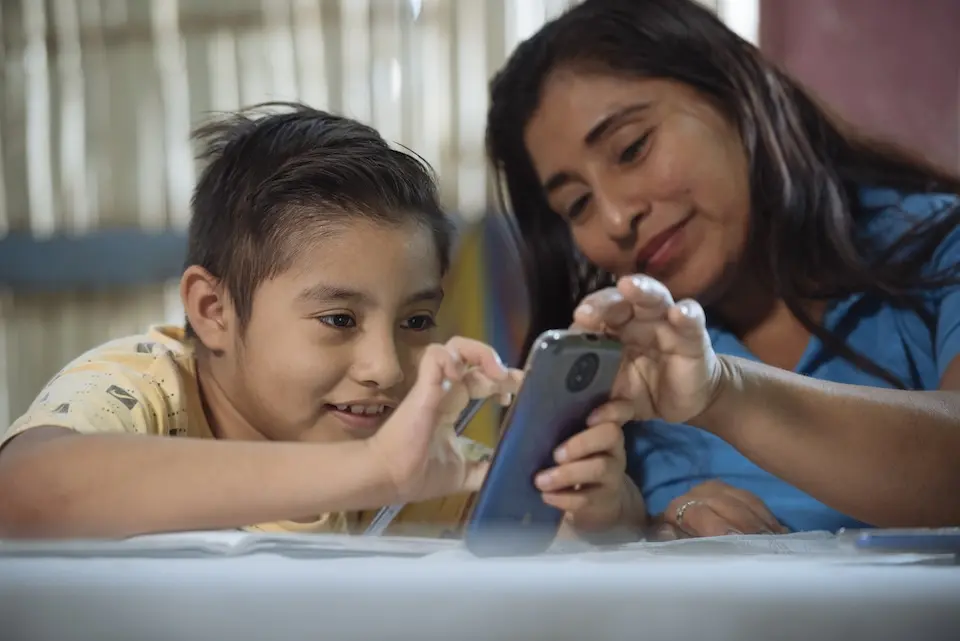
Exploring AI together can also make these ideas more concrete. For example, if a child has a question, you could type it into a chatbot with them and look at the answer together. Then you can talk about what the tool did: Which parts of the answer seem helpful? Which parts seem confusing or not quite right? How might the tool have created that response?
Using simple examples from home, along with shared moments of exploration, helps children build an early sense of what AI can and cannot do. It also gives caregivers a natural way to guide children’s thinking as they encounter these tools in their daily lives.
How can AI help to promote learning in children and teens?
YING XU: AI can support children’s learning in several ways. Many tools can explain ideas clearly, answer questions on demand, and provide personalized practice. Research shows that when AI systems are designed to teach specific skills or knowledge, children often learn just as effectively from these tools as they do from human instructors. For busy families, AI can also offer quick, accessible help when an adult is not immediately available.
At the same time, there are important concerns. Studies have found that some children begin to offload their learning responsibilities to AI. While this can sometimes be seen as a form of support, many educators worry that too much assistance may take away children’s productive struggle, which is important for long-term learning.
Students themselves often recognize this risk. Surveys suggest that some students feel relying on AI can negatively affect their ability to think through problems and solve them independently. An even bigger concern is habit formation: Once children develop a habit of turning to AI for answers, that reliance can be difficult to reverse – even when they want to break that habit.
How can parents teach their children to protect their privacy when using AI?
YING XU: AI tools vary widely in the types of information they collect. Some systems require basic details to create an account, such as a child’s age, a parent’s contact information, or billing details for paid apps. Beyond this, many families are concerned about the personal information children may share during everyday use. This can include their name, school, home routines, friendships or feelings.
What counts as “sensitive information” is not always obvious to children. Some examples, like a home address or phone number, are easier to recognize. Others depend on context. For instance, when a child or teen uses AI to ask about emotions, friendships, or health, they may reveal highly personal information without realizing how sensitive it is.
Supporting children’s privacy involves both practical steps and ongoing conversations. Parents can review privacy settings together with their child, check what data different platforms collect, and encourage kids to pause before sharing details about themselves or others. Talking regularly about what feels safe to disclose and what might be better kept private helps children build good habits over time.
At the same time, the responsibility cannot fall only on families. Technology companies and policymakers also need to create safer defaults. That includes limiting how long data is stored, reducing unnecessary data collection and being clear about how information is used. Young people are still learning how to judge risk, so products should be designed with their needs and vulnerabilities in mind. Effective privacy protection requires both informed families and accountable systems.
Learn more: Strategies for keeping kids safe online
How can parents support their children to develop AI-literacy?
YING XU: Many adults feel unsure about how to guide their children when AI is evolving so quickly. It can be helpful to move away from the idea that parents must always act as experts or supervisors. Right now, adults and children are often learning at a similar pace, and approaching AI as co-learners, being open, curious, and willing to navigate uncertainties together, can be an effective starting point.
For caregivers with limited time to learn new technologies from scratch, there are accessible external resources that can play an important supporting role. For example, Common Sense Media now offers ratings for some AI apps, which can provide parents with a helpful entry point.
Some schools also maintain lists of AI tools approved for classroom use, particularly in areas such as reading and mathematics. These tools typically undergo some level of internal vetting and can offer families a practical and trustworthy starting point, especially for caregivers with limited time or technical expertise.
What are some of the dangers that AI can pose for children?
YING XU: When people talk about the risks of AI for children, the focus is often on the technology itself – things like data privacy, inappropriate content or manipulative design. These concerns are important. Some AI tools collect children’s personal information, expose them to misleading or harmful material, or encourage sharing in ways that are not developmentally appropriate. Others are designed to keep children engaged in ways that may serve commercial goals rather than children’s well-being.
However, the potential risks of AI are not only about how these products are built. They also relate to how children grow, learn and form relationships.
In some situations, AI interactions can seem helpful. For example, a child might get reassurance from an AI when they are nervous about starting a new school, or receive step-by-step help with homework. These experiences can feel supportive in the moment.
At the same time, there are longer-term concerns to keep in mind. One is that children may start to rely on AI instead of turning to other people. In our research with teenagers, some shared that talking to AI feels easier than talking to peers or adults. While we do not yet know whether AI actually replaces time spent with others, this preference is worth paying attention to.
Another concern is about expectations for relationships. Real relationships involve disagreement, compromise and working through conflict. Many AI systems, by design, are always agreeable and encouraging. If children spend a lot of time with systems like this, they may develop unrealistic ideas about how friendships and relationships work.
Finally, growing up involves learning how to handle social challenges. If AI interactions take the place of real-life experiences, children may miss opportunities to practice important skills such as communication, empathy and conflict resolution.
What are some of the warning signs that a child’s interactions with AI is unhealthy?
YING XU: Some helpful warning signs include:
- excessive use — long periods of chatting with AI or distress when asked to stop
- changes in behavior — becoming secretive, more anxious or relying on AI for emotional support instead of trusted people
- displacement — AI use starting to crowd out sleep, schoolwork, time with friends or hobbies
If parents notice these patterns, it’s best to start with gentle, open questions rather than criticism. Asking what the child likes about the tool and whether anything feels unhelpful can open up a calm conversation. Together, families can then agree on simple boundaries and regular check-ins to keep AI use balanced.
For decision-makers and developers: UNICEF’s guidance on AI and children
Learn more: check out UNICEF USA's Parenting Resources
UNICEF works in over 190 countries and territories to support and protect children in need.
HOW TO HELP
There are many ways to make a difference
War, famine, poverty, natural disasters — threats to the world's children keep coming. But UNICEF won't stop working to keep children healthy and safe.
UNICEF works in over 190 countries and territories — more places than any other children's organization. UNICEF has the world's largest humanitarian warehouse and, when disaster strikes, can get supplies almost anywhere within 72 hours. Constantly innovating, always advocating for a better world for children, UNICEF works to ensure that every child can grow up healthy, educated, protected and respected.
Would you like to help give all children the opportunity to reach their full potential? There are many ways to get involved.